
Disclosure: This post contains affiliate links. As an Amazon Associate, we earn a small commission from qualifying purchases at no extra cost to you. We only recommend products we truly love and trust.
As someone who is passionate about babies and toddlers, in this article we will introduce you to smart baby monitors designed to help parents keep an eye on their little ones. We will also discuss their advantages and disadvantages to give you a clear overview and help you make a well-informed choice for your family.
Bringing a newborn home is a beautiful, life-changing milestone—but let’s be honest, it is also terrifying. If you are a new parent, you already know the drill: you put your baby to sleep, tip-toe into your own bed, and just as you are about to close your eyes, the overwhelming urge to check if they are breathing kicks in. This constant “sleep-checking” cycle leads to severe parental sleep deprivation, heightened anxiety, and exhaustion.
Standard video monitors let you see your baby, but they demand your constant attention. You have to actively stare at a screen to know they are safe. What if there was a way to be proactively notified only when your baby actually needs you?
Enter the wearable smart baby monitor. In this comprehensive guide, we are diving deep into the world of smart socks, breathing bands, and wearable clips. We will review the top-performing devices on the market, break down exactly how they work, and help you find the perfect digital safety net so you (and your baby) can finally get a good night’s sleep.
- Why You Still Need It: The Core Benefits of Smart Wearables
You might be wondering: “I already have a standard video camera, do I really need a wearable monitor?” The short answer is a resounding yes.
While traditional monitors are reactive (you hear a cry, then you check), wearable monitors are proactive. They use hospital-grade technology like pulse oximetry and motion sensors to track your baby’s most critical vitals—heart rate and blood oxygen levels—in real-time.
From a health and practical standpoint, these devices are game-changers:
Ergonomic Peace of Mind: You no longer need to physically bend over the crib in the dark, straining your back and risking waking the baby just to check their chest movements.
Proactive Safety: If your baby’s oxygen drops or their heart rate spikes beyond preset safe zones, the base station and your phone will instantly sound a loud, distinct alarm.
Actionable Sleep Data: Beyond safety, these wearables track sleep cycles, helping you understand your baby’s sleep habits and establish healthy routines early on.
👉 Click the link to check the price on Amazon
- Top Products Review: Best Wearable Monitors of 2026
- Owlet Dream Sock (FDA-Cleared)

- Primary Feature: Medically accurate, FDA-cleared pulse oximetry technology that tracks live oxygen levels and heart rate.
Best For: Extremely anxious parents looking for the most trusted, clinically validated digital safety net on the market.
Detailed Review: The Owlet Dream Sock is the undisputed king of the smart wearable niche. It wraps comfortably around your baby’s foot and uses advanced light sensors to read vitals through the skin. The companion app is beautifully designed, offering live readings and historical sleep trends. The included Base Station glows green to let you know everything is okay, but will flash red and sound a loud alarm if vitals fall out of the safe range. Because it is now officially FDA-cleared for healthy infants, you are getting genuine medical-grade accuracy in your nursery.
Pros & Cons:
Pros: FDA-cleared accuracy; intuitive app; excellent sleep tracking; comfortable for the baby.
Cons: Premium price tag; requires a stable 2.4GHz Wi-Fi connection.
👉 Click the link to check the price on Amazon
- Nanit Pro Camera + Breathing Band

- Primary Feature: Sensor-free breathing motion tracking paired with an incredible 1080p overhead HD camera.
Best For: Parents who want comprehensive sleep tracking and breathing monitoring without attaching any electronic sensors to their baby’s skin.
Detailed Review: The Nanit Pro takes a completely different approach to wearable tech. Instead of a smart sock, Nanit uses a custom-patterned fabric Breathing Band that goes over the baby’s swaddle or pajamas. The overhead Nanit camera reads the micro-movements of this pattern to track breathing in real-time. If the camera detects a pause in breathing, it sounds an alarm. It’s brilliant because there are no batteries to charge on the wearable itself, and no electronics touching your infant. Plus, Nanit’s sleep analytics and daily highlight videos are unmatched.
Pros & Cons:
Pros: No electronics touching the baby; outstanding HD video quality; incredible sleep analytics.
Cons: Camera must be mounted directly overhead; requires a paid subscription for premium data features.
👉 Click the link to check the price on Amazon
- eufy Baby Smart Sock
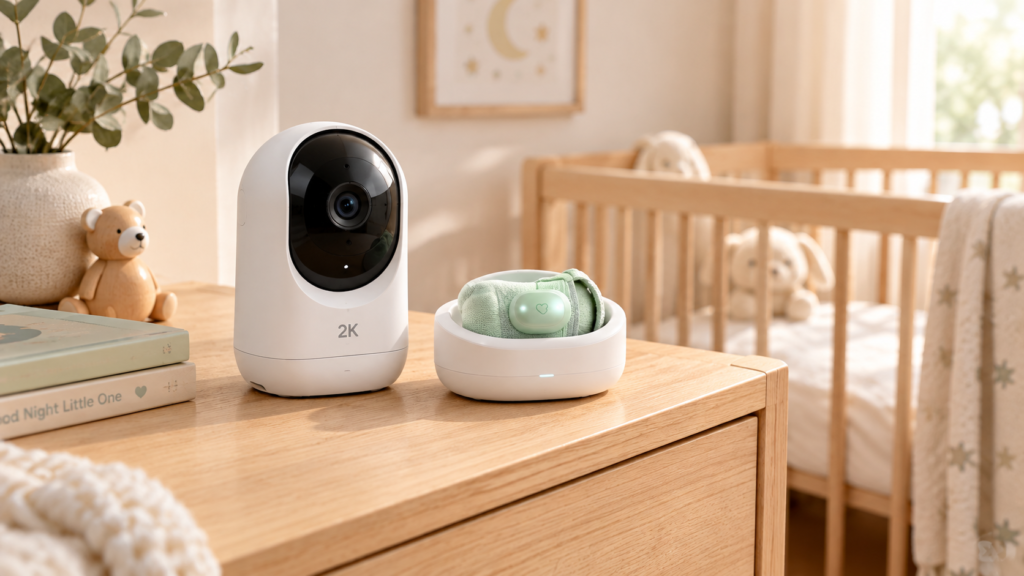
- Primary Feature: A highly integrated ecosystem featuring a 2K camera and a reliable smart sock with no monthly subscription fees.
Best For: Tech-savvy parents who want a high-quality, all-in-one bundle (camera + sock) at a highly competitive price point.
Detailed Review: eufy has aggressively entered the baby monitor space with this fantastic Smart Sock bundle. It monitors heart rate, oxygen levels, and sleep state just like its premium competitors. What makes the eufy sock stand out is its seamless integration with the included 2K pan-and-tilt camera and the fact that all your data is stored locally. The battery life on the sock is phenomenal, lasting up to 24 hours on a single charge. Furthermore, there are no hidden subscription walls; you get access to all sleep data right out of the box.
Pros & Cons:
Pros: Excellent value (includes 2K camera); no subscription fees; exceptional 24-hour battery life.
Cons: The sock can be slightly bulkier than the Owlet; app interface is a bit cluttered with other eufy home devices.
👉 Click the link to check the price on Amazon
- Sense-U Baby Monitor 3
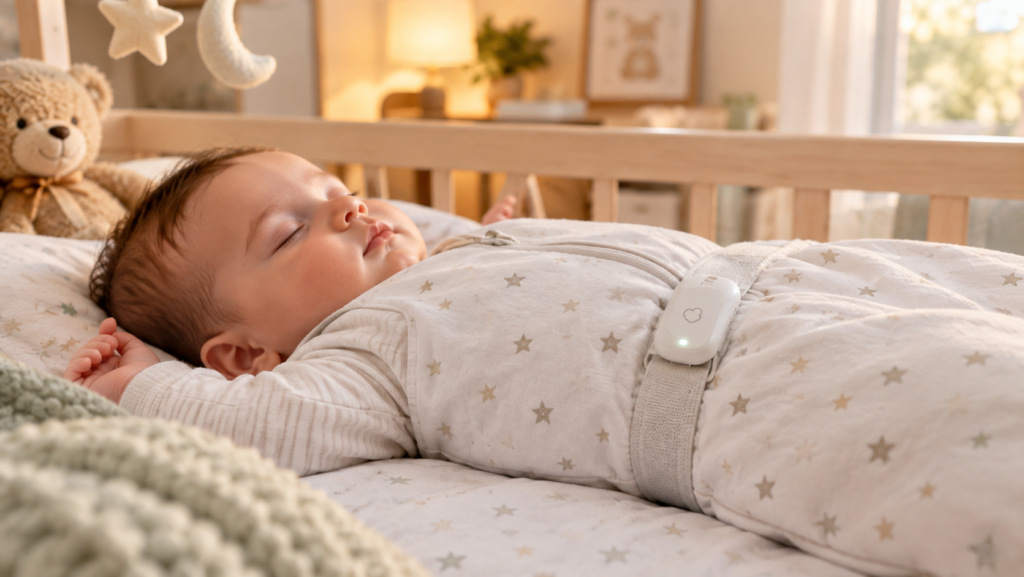
- Primary Feature: A tiny clip-on device that tracks breathing movement, ambient temperature, and rollover alerts.
Best For: Budget-conscious parents and those particularly worried about their baby rolling onto their stomach during the night.
Detailed Review: If you don’t want to deal with socks or overhead cameras, the Sense-U is a minimalist dream. It’s a small, lightweight button that clips securely onto the waistband of your baby’s diaper or sleep sack. It tracks abdominal breathing movements and will alert you if motion stops for 15 seconds. Uniquely, it also tracks the baby’s body temperature to prevent overheating and has a highly sensitive rollover alert to let you know if your newborn has flipped onto their tummy before they are capable of rolling back.
Pros & Cons:
Pros: Very affordable; detects stomach sleeping; tracks body temperature.
Cons: Prone to false alarms if not clipped tightly; uses replaceable coin batteries instead of a rechargeable base.
👉 Click the link to check the price on Amazon
- Comprehensive Buyer’s Guide: How to Choose the Right Wearable
Choosing the ideal wearable smart baby monitor is far more complex than picking out a cute outfit or crib sheet. Because this device directly tracks your infant’s vital signals, making an informed choice requires looking past flashy marketing claims and diving into the underlying technology. Below is an exhaustive breakdown of the critical parameters every parent must evaluate before hitting the buy button.
Safety, Medical Regulations, and Clinical Validation
Not all smart monitors are created equal in the eyes of regulatory bodies. Historically, consumer-grade wearables sat in a legal gray area classified strictly as “wellness devices.” Today, market leaders have shifted toward rigorous clinical testing. When shopping, check whether the device holds official FDA clearance (such as 510(k) status) for infant monitoring. FDA-cleared devices have undergone stringent clinical trials to prove that their pulse oximetry sensors read blood oxygen saturation (SpO_2) and pulse rates with high precision, even when infants kick or squirm. If a device lacks clinical validation, it may still provide general sleep insights, but it should not be relied upon as a clinical-grade alarm system.
Form Factor, Sensor Contact, and Infant Skin Health
The physical design of the monitor determines both comfort for your baby and convenience for you. Wearables generally fall into three design categories:
Skin-Contact Wearables (Smart Socks): These sit snugly against your baby’s foot. While highly accurate, parents of infants with sensitive skin, eczema, or contact dermatitis should monitor for localized irritation. Ensure the fabric is hypoallergenic, latex-free, and machine-washable.
Non-Contact Vision Systems (Breathing Bands): Devices like the Nanit utilize computer-vision cameras to read geometric patterns printed on fabric bands wrapped around the chest. Because zero electronics touch the baby’s body, there is no risk of skin burns, sensor pressure marks, or EMF exposure at the skin level.
Diaper Clips and Wearable Buttons: Small sensors that attach to waistband fabric track movement via motion accelerometers. These are ultra-portable but rely on physical proximity to the abdomen.
Battery Dynamics, Charging Speed, and Dock Station Mechanics
A smart sock that dies at 3:00 AM creates unnecessary panic and disruptive false alarms. Evaluate the battery architecture thoroughly:
Runtime per Charge: Look for devices offering a minimum of 16 to 24 hours of continuous monitoring on a single charge.
Fast-Charging Capability: Premium models feature magnetic drop-and-go charging docks that deliver 8 to 12 hours of operation from a quick 20-minute charge—ideal during the baby’s evening bath routine.
Battery Degradation: Lithium-ion batteries inside small wearables degrade over months of daily use. Choose brands that sell affordable replacement socks or standalone battery modules.
Connectivity, Localized Alarms, and Network Reliability
How the device communicates data determines how reliable it remains during a Wi-Fi outage. Look for dual-layered notification systems:
Localized Base Station Alarms: The physical base station should connect directly to the wearable via Bluetooth Low Energy (BLE) independent of your home internet. If your Wi-Fi router crashes or your internet provider goes down, the physical dock must still sound an audible alert in your home.
Wi-Fi and Cloud Security: Apps that stream data over 2.4GHz home Wi-Fi should feature end-to-end AES 128-bit or 256-bit encryption to prevent unauthorized access.
Smart Home Integration: Consider whether the monitor integrates seamlessly into existing smart platforms like Amazon Alexa, Google Home, or Apple HomeKit.
Total Cost of Ownership and Hidden Subscriptions
The sticker price is rarely the final cost. Before purchasing, check if access to long-term sleep trends, video clip history, or advanced developmental insights requires a monthly or annual subscription fee. Additionally, factor in the cost of growing sock/band sizes, as most babies transition through 2 to 3 sock sizes during their first year. - Pro Tips & Hacks for Daily Use
Maximized performance and minimal frustration come down to operational best practices. Here are battle-tested strategies used by experienced parents to optimize daily monitor performance:
The “Bath Time & Diaper Change” Docking System
Establish a strict, non-negotiable routine: remove the wearable during evening bath time or night feedings and immediately snap it onto the charging dock. Just 20 to 30 minutes on the dock during nighttime prep ensures the unit remains fully charged throughout a 12-hour sleep stretch, preventing low-battery chime alerts in the dead of night.
Eradicating False Alarms (Mastering Sensor Placement)
Over 80% of middle-of-the-night “placement” or “yellow” alerts stem from improper fit rather than vital abnormalities.
The Pinky Toe Rule: When putting on a smart sock, ensure the optical sensor dome aligns directly over the outer edge of the foot, just below the baby’s pinky toe.
Snugness Test: The sock should fit comfortably snug like a glove—too loose, and ambient room light leaks into the sensor causing false low readings; too tight, and it can cause pressure marks.
Sizing Transitions: As soon as your baby’s toes touch the end of the fabric, size up immediately to prevent sensor misalignment caused by foot growth.
Thermal Layering and Overgarments
Wearable sensors require direct skin contact to transmit infrared light accurately. However, you can safely layer over them. Place the smart sock directly against the bare foot first, then pull regular cotton socks, footed onesies, or sleep sacks over top. The additional clothing layers will keep your baby warm without interfering with the internal sensor array or wireless transmission.
Travel Hacks for Smart Wearables
When traveling to grandparents’ houses or hotels, native Wi-Fi setups can be tricky. Carry a portable travel router or use a secondary smartphone as a dedicated Wi-Fi hotspot to maintain seamless communication between the base station and smartphone app. - Frequently Asked Questions (FAQs)
Are wearable smart baby monitors safe from electromagnetic radiation (EMF)?
Yes, wearable monitors are exceptionally safe. Devices that rest against your infant’s skin utilize ultra-low-power Bluetooth Low Energy (BLE) technology. The radio frequency (RF) emissions from BLE wearables are a tiny fraction of those emitted by a standard smartphone, a handheld tablet, or even a home Wi-Fi router. Furthermore, non-contact systems like breathing bands emit zero radiation whatsoever, as they consist entirely of printed fabric.
Do smart socks and wearable monitors prevent SIDS?
No. It is medically vital for parents to understand that no consumer product or medical device can prevent Sudden Infant Death Syndrome (SIDS). Smart wearables are monitoring tools designed to measure vital trends and notify parents if parameters drift outside set thresholds, providing an opportunity for early intervention. They should never replace American Academy of Pediatrics (AAP) safe sleep guidelines: placing infants on their backs, utilizing a firm, flat mattress, keeping cribs free of loose blankets or pillows, and room-sharing without bed-sharing.
Can I use my HSA or FSA tax-advantaged account to purchase a smart monitor?
In many instances, yes! Because high-end wearables (like the Owlet Dream Sock) hold official FDA clearances, they are categorized as eligible medical expenses under most Health Savings Accounts (HSA) and Flexible Spending Accounts (FSA). You can purchase them directly with your HSA/FSA debit card or submit an itemized purchase receipt for tax-free reimbursement.
At what age should you stop using a wearable smart monitor?
Most parents utilize wearable monitors from birth up until the baby is between 12 and 18 months old. By this milestone, infants have established more predictable sleep architecture, can easily roll over independently, and have significantly lower risks of nighttime respiratory distress. Most manufacturers include wearable sock sizes that fit comfortably up to 18 months or 30 lbs. - Conclusion
Navigating the uncharted waters of early parenthood is one of the most rewarding yet exhausting journeys you will ever undertake. Sleep deprivation and constant worry do not have to be an inevitable rite of passage. A high-quality wearable smart baby monitor is far more than a luxury tech gadget—it is an invaluable investment in your family’s daily well-being and nightly peace of mind.
Whether you select the clinically validated precision of an FDA-cleared smart sock, the non-contact elegance of a pattern-reading computer vision camera, or a budget-friendly clip-on movement sensor, you are establishing a protective digital safety net. Take time to assess your nursery layout, skin health priorities, and connectivity needs. By making an informed choice today, you can look forward to restful nights, actionable sleep insights, and the priceless reassurance that your little one is safe, sound, and sleeping peacefully.
And with that, I have provided you with all the information you need to choose the right product for your little ones. Thank you for taking the time to read our article!