
Disclosure: This post contains affiliate links. As an Amazon Associate, we earn a small commission from qualifying purchases at no extra cost to you. We only recommend products we truly love and trust.
As someone who is passionate about baby and toddler products, I always strive to introduce you, as parents, to useful products and explain their features in a simple and clear way. I also share their advantages and disadvantages to make it easier for you to compare your options and choose the right product for your little ones. I hope this article provides you with helpful information and answers your questions about this topic.
You walk into your living room after a long workday, only to step directly onto a sharp plastic building block. Visual clutter overwhelms every corner: overflowing fabric bins, mismatched puzzle pieces scattered across the rug, and deep toy chests crammed with forgotten plastic gadgets. Your toddler stands in the middle of it all, visibly overwhelmed, pulling down entire baskets only to play with a single item for thirty seconds before abandoning it.
This daily frustration is not a behavioral issue—it is a design flaw in traditional playroom storage. Giant, deep toy boxes act as “toy graveyards” where playthings go to disappear. When toddlers cannot see their options clearly, they dump out entire bins out of frustration, leading to overstimulation, shortened attention spans, and endless clean-up battles for parents.
The Montessori approach to organization solves this precise daily headache. By replacing deep, chaotic toy bins with low-profile, open wooden shelving and accessible trays, you create a serene environment that fosters independence, concentration, and natural order. In this comprehensive buyer’s guide, we review the top-rated Montessori toy storage organizers on the market, break down the child development benefits of minimalist play spaces, and share practical playroom organization hacks to restore peace to your home.
Why You Still Need Montessori Toy Storage: Core Benefits for Child Independence
Shifting to a Montessori storage system is far more than a decorative trend—it is an investment in your child’s cognitive and motor development. Unlike traditional toy chests that encourage hoarding and dumping, open Montessori storage delivers fundamental developmental advantages:
Promoting Autonomy and Independent Play: Low-height shelves place playthings directly at your toddler’s eye level and within arm’s reach. Children can select what they want to play with, carry it to their play mat, and return it independently without relying on an adult.
Preventing Visual Overstimulation: Too many choices overwhelm a developing brain. Montessori storage relies on curated, spaced-out displays that encourage children to focus deeply on one task at a time, dramatically expanding their attention span.
Developing Order and Fine Motor Skills: When every toy has a designated, clearly visible spot on a shelf, children naturally internalize spatial organization. The physical act of grasping shallow wooden trays or carrying lightweight bins refines gross and fine motor coordination.
Ergonomic Safety and Easy Cleanup: Heavy toy chest lids pose serious pinch hazards for small fingers. Open-faced Montessori shelves eliminate lid hazards altogether, while making the cleanup routine a predictable, stress-free part of playtime.
👉 Click the link to check the price on Amazon
Detailed Reviews: Top 5 Montessori Toy Storage Organizers for Toddlers
We evaluated dozens of toddler organizers based on material safety, shelf accessibility, durability, anti-tip stability, and aesthetic integration into modern home decor. Here are the elite choices for your Montessori playroom.
- ECR4Kids Birch Streamline 2-Shelf Storage Cabinet
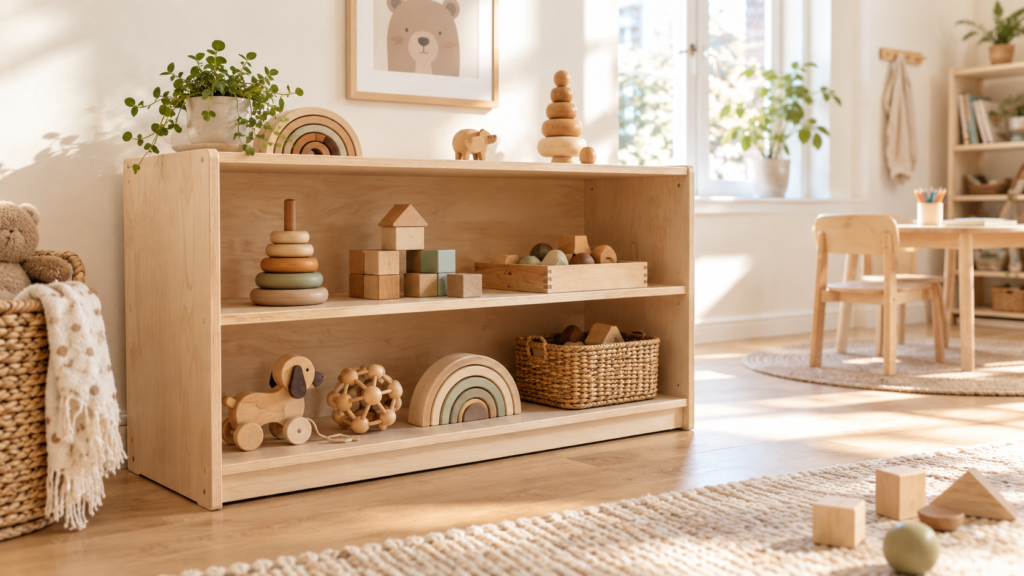
Primary Feature: Premium, sustainably harvested birch hardwood construction with a multi-step non-toxic UV finish that resists scratching and yellowing.
Best For: Parents seeking a commercial-grade, authentic Montessori shelf built to last through multiple children.
Detailed Review
The ECR4Kids Birch Streamline Cabinet represents the gold standard in authentic Montessori playroom design. Crafted from natural birch plywood with rounded, child-safe edges, this low-profile unit stands at a perfectly tailored height for toddlers learning to stand and explore independently.
The two wide, open shelves provide ample surface area to layout wooden trays, practical life activities, and sensory baskets without crowding. The low center of gravity makes it exceptionally stable, and the natural wood grain brings a soothing, minimalist aesthetic to any nursery or living area. Its smooth UV-cured finish wipes down easily with a damp cloth, enduring years of active paint, marker, and water play.
Pros:
Authentic Montessori design with open, spacious wooden shelves.
GREENGUARD Gold certified for low chemical emissions into indoor air.
Exceptional structural durability made from solid birch hardwood.
Cons:
Requires assembly and is heavier than composite wood alternatives.
👉 Click the link to check the price on Amazon
Sprout Kids Wooden Montessori Low Toy Shelf with Bins
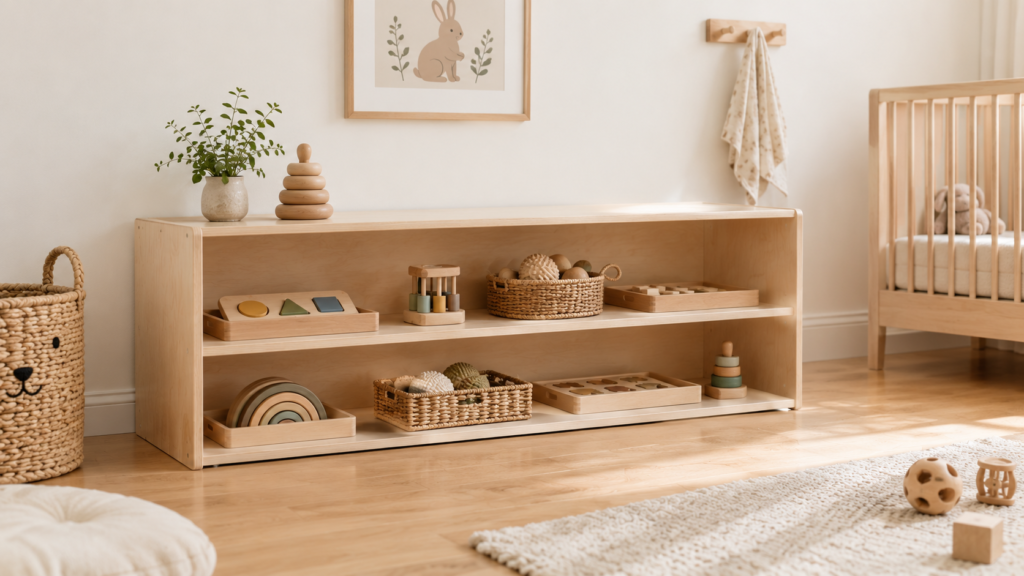
Primary Feature: Tool-less tension-lock assembly system made from eco-friendly Baltic birch, featuring modular shelf dividers and optional shallow wooden bins.
Best For: Families wanting a modular, customizable system that grows alongside their child’s shifting activity needs.
Detailed Review
Sprout Kids specializes exclusively in Montessori-aligned children’s furniture, and their low toy shelf is a masterpiece of functional design. Designed specifically for infants and young toddlers, this shelf features an ultra-low height that allows even crawling babies to reach items safely from the bottom tier.
The standout feature of Sprout Kids shelving is its patented joint assembly—you can construct or disassemble the entire unit without using a single screw or Allen wrench. The backboard prevents small toys from sliding behind the unit, while optional shallow wooden bins allow you to organize small loose parts like wooden blocks or animal figurines seamlessly.
Pros:
Tool-less, rapid assembly and disassembly.
Ultra-low profile tailored specifically for infant and toddler accessibility.
Sustainably sourced Baltic birch with smooth, rounded corners.
Cons:
Higher initial investment compared to mass-market plastic organizers.
👉 Click the link to check the price on Amazon
Humble Crew Extra-Large Toy Organizer with Storage Bins
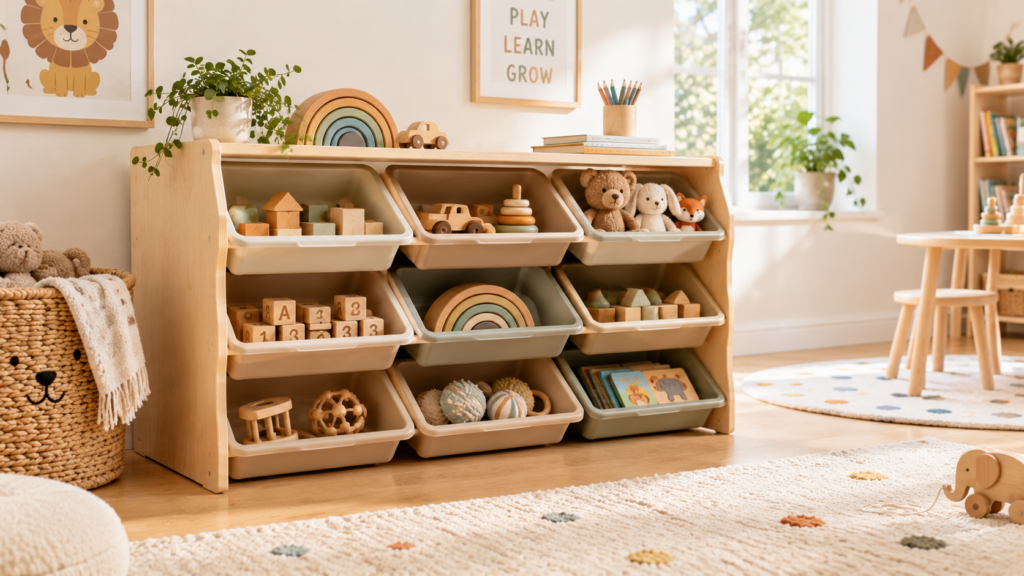
Primary Feature: A sturdy engineered wood frame supporting 16 removable, angled plastic storage bins in varying sizes.
Best For: Families with large playrooms needing a budget-friendly hybrid that combines Montessori visibility with high-capacity bin sorting.
Detailed Review
While pure Montessori philosophy leans toward natural wood, many busy households require a hybrid solution that manages large volumes of mixed toys. The Humble Crew Extra-Large Organizer bridges this gap effectively by angling its removable bins outward, ensuring children can see all contents without dumping the entire bin onto the floor.
The open-top plastic bins are lightweight, allowing toddlers to pull down a single bin (such as a bin of train tracks), carry it to their play mat, and return it when finished. The sturdy wooden side panels provide structural rigidity, while the color-coded or neutral-toned bins help teach basic sorting and categorization skills during tidy-up time.
Pros:
Excellent storage capacity for high volumes of toys and building sets.
Angled bin placement maintains visual accessibility for small children.
Extremely budget-friendly price point for growing families.
Cons:
Plastic bins lack the pure natural aesthetic of classic wooden Montessori furniture.
👉 Click the link to check the price on Amazon
KidKraft Wooden Low Toy Storage Bench & Bin Unit
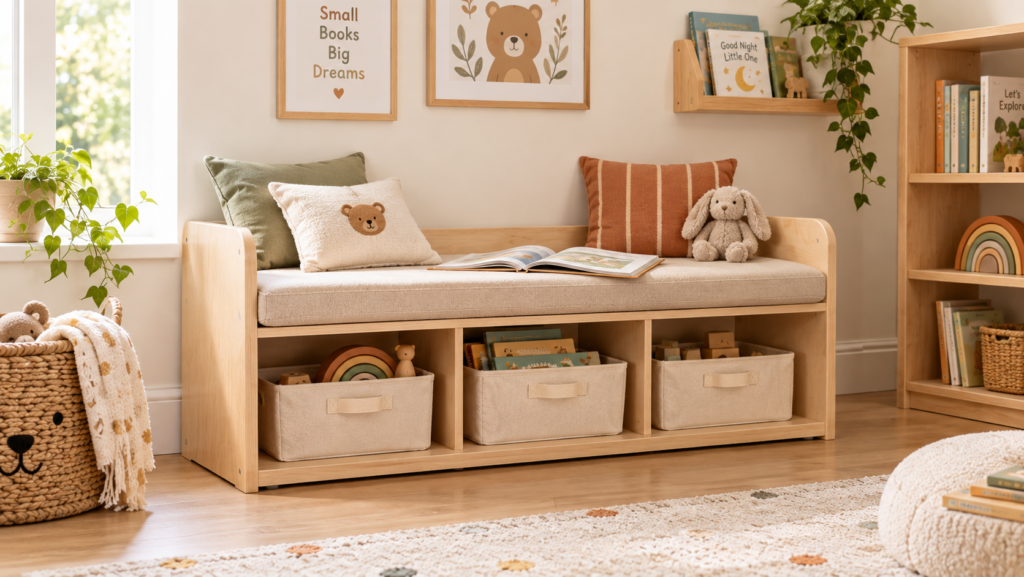
Primary Feature: A dual-purpose low wooden bench featuring deep open cubbies designed to hold flat activity trays or fabric storage drawers.
Best For: Small spaces, bedrooms, or living rooms where storage furniture must double as a comfortable toddler reading bench.
Detailed Review
For families balancing limited square footage, the KidKraft Low Storage Bench provides a smart 2-in-1 layout. The top surface acts as a sturdy bench seat where toddlers can sit to read books or put on shoes, while the lower section features spacious open cubbies ideal for low-profile Montessori displays.
Constructed from sturdy engineered wood with reinforced corners, this unit keeps toys organized while maintaining a clean, furniture-grade appearance that blends smoothly into shared family spaces. You can use the cubbies as open wooden shelves or insert shallow canvas bins to conceal art supplies or loose building pieces.
Pros:
Dual-function design provides both seating and accessible toy storage.
Sleek modern finish complements living room decor seamlessly.
Heavy-duty frame supports toddler sitting weight easily.
Cons:
Cubby depth requires using trays to keep small items near the front edge.
👉 Click the link to check the price on Amazon
UTEX 3-Tier Open Wooden Toy Storage Organizer
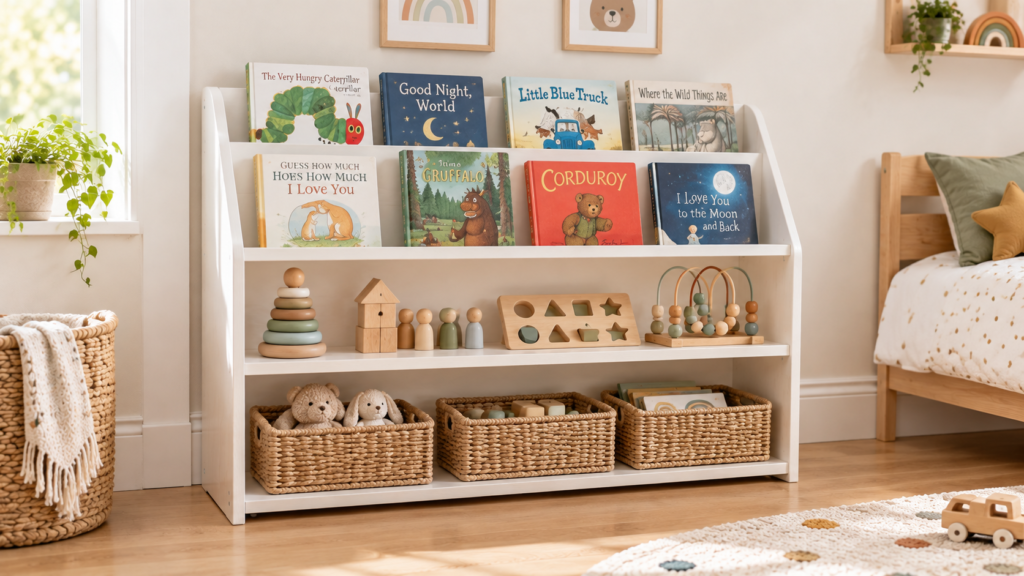
Primary Feature: A vertical 3-tier open display rack with front lips to keep books, wooden puzzles, and activity boards upright and accessible.
Best For: Nurseries and small play corners requiring vertical storage that highlights book covers and puzzle boards.
Detailed Review
The UTEX 3-Tier Open Organizer is designed to showcase toys and books as inviting choices rather than hidden clutter. The top tier features forward-facing book slots—a staple in Montessori language environments that encourages early reading by displaying cover art—while the lower tiers provide wide, open bins for sensory toys and wooden play sets.
Made from durable MDF with a crisp white or espresso non-toxic painted finish, this unit incorporates an anti-topple wall anchor kit to ensure complete safety when curious toddlers pull themselves up to reach top items. Its compact footprint makes it a favorite for small urban apartments.
Pros:
Combines forward-facing book display with open toy bin storage.
Includes wall-anchoring safety hardware out of the box.
Compact footprint fits narrow walls and small bedroom nooks.
Cons:
Painted finish can show scratches over time if hit with hard plastic toys.
👉 Click the link to check the price on Amazo
Comprehensive Buyer’s Guide: How to Select the Ideal Montessori Toy Storage
Transitioning to a Montessori-aligned playroom is a highly intentional process. Selecting the right storage unit requires understanding both your physical living space and your child’s rapidly changing physical capabilities. Rather than simply buying another piece of furniture, you are designing an environment that dictates how your child interacts with the world. Use these five critical criteria to select the perfect organizer for your home:
- Height and Vertical Accessibility (The Child’s Line of Sight)
The fundamental, non-negotiable rule of Montessori furniture is that it must fit the child, not the adult. A toddler’s line of sight is drastically lower than ours. For infants and young toddlers (ages 1 to 3), the top shelf height should strictly not exceed 24 to 30 inches from the floor. This exact measurement allows the child to view, reach, and replace every displayed item comfortably without standing on tiptoes, dragging over a stepping stool, or pulling dangerously on the shelf edges. When a child can independently access their materials, you eliminate the frustration of having to constantly ask an adult for help, fostering a deep sense of autonomy. - Open Shelving vs. Closed Deep Boxes (Visual Clarity)
You must actively avoid traditional toy chests with deep cavities, opaque sides, and heavy hinged lids. Instead, look for open-backed or solid-backed horizontal shelving units. Traditional toy boxes operate as “toy graveyards”—a chaotic jumble where pieces get lost at the bottom. When children cannot see what is inside, they resort to destructive dumping just to find one specific item. Open shelves, on the other hand, force you to limit the number of toys displayed at one time. This creates an inviting, breathable visual environment. The negative space (empty space) between each toy on an open shelf acts as a visual resting place, preventing sensory overload and inspiring purposeful, concentrated play. - Material Safety and Non-Toxic Finishes (Indoor Air Quality)
Toddlers explore the world with their mouths and frequently touch furniture edges while navigating a room. Therefore, prioritize storage units constructed from solid hardwood (such as birch, pine, or rubberwood) or high-grade, formaldehyde-free Baltic birch plywood. It is critical to ensure that all finishes, paints, and sealants are certified non-toxic, lead-free, and low-VOC (Volatile Organic Compounds). Look for industry-leading safety credentials like GREENGUARD Gold or CPSIA compliance, which guarantee the furniture will not off-gas harmful chemicals into your child’s play area. Furthermore, smooth, machine-sanded, and rounded corners are absolutely essential to prevent severe bumps and bruises during active, physical play. - Structural Stability and Anti-Tip Anchoring
Toddlers inherently use low shelving as leverage when learning to pull themselves up to stand, or they may attempt to climb shelves to reach an item placed out of bounds. The storage unit you choose must feature a wide, heavy base with a remarkably low center of gravity. However, regardless of the shelf’s height, weight, or base width, you must always secure every single piece of playroom furniture to your wall studs using heavy-duty, metal anti-tip safety straps. This is a non-negotiable safety standard in any child-friendly home to prevent catastrophic tipping accidents. - Capacity, Spacing, and Toy Rotation Compatibility
A common mistake parents make is attempting to fit every toy their child owns onto a single newly purchased shelf. The primary goal of a Montessori storage system is to display only 6 to 10 highly curated activities at a given time. Choose a shelf layout that accommodates shallow wooden trays, small woven baskets, and open space. The shelves should be deep enough (usually 11 to 15 inches) to hold standard Montessori activity trays without them hanging precariously off the edge. This carefully measured capacity allows you to maintain order and easily rotate toys in and out from a hidden storage closet every few weeks.
Pro Tips & Hacks for a Flawless Montessori Playroom
Transforming your play area involves significantly more than just buying a new wooden shelf; it requires setting up a sustainable, long-term organizational system. Follow these expert strategies to maximize your child’s engagement: - Implement a Bi-Weekly Toy Rotation System
Do not let your beautiful new shelf become cluttered. Store roughly 70% to 80% of your total toy inventory inside high closet bins completely out of your child’s sight. Display only 8 to 10 high-quality toys or complete activities on your open Montessori shelf. Every two weeks, observe what your child has stopped playing with and swap those items with “fresh” toys from the closet. To your toddler, these rotated toys will feel brand new, instantly rekindling their engagement and extending the lifespan of every toy you purchase. - Use Shallow Trays to Isolate Loose Parts
Present multi-piece activities—such as wooden bead threading, interlocking building blocks, or matching puzzles—on shallow wooden or bamboo trays with built-in handles. Rather than grabbing a handful of loose pieces, this setup teaches your child to pick up the tray by the handles, carry the complete activity to their designated play mat in one single trip, and return it without dropping small pieces along the way. - Group Items by Activity Type (The Left-to-Right Setup)
Organize your shelves with intention. Arrange items on the shelf from the simplest activity on the left to the most complex activity on the right, and from the top shelf down to the bottom. This left-to-right, top-to-bottom organization intentionally mimics the natural tracking of reading and writing in Western languages. Keep language and reading items grouped together, fine motor puzzles in their own section, and practical life activities neatly aligned. - Label Shelf Spots with Real Visual Picture Icons
For older toddlers (ages 2.5 and up), print small, clear photographs of each specific toy (do not use generic cartoon clip art) and place the photo sticker discreetly on the wooden shelf surface directly where the item belongs. This clever visual cue turns daily clean-up time into an enjoyable, independent matching game. Your toddler will know exactly where each item lives, fostering a deep sense of responsibility and environmental order.
Frequently Asked Questions (FAQs)
What exactly makes a toy storage unit “Montessori”?
A storage unit is considered “Montessori-aligned” if it is built low to the ground, is completely accessible to the child without requiring adult assistance, features open, horizontal shelving rather than deep, enclosed boxes with lids, and prioritizes natural, high-quality, non-toxic materials (like solid wood) over bright, flashy plastics.
How many toys should be displayed on a Montessori shelf at once?
For toddlers between the ages of 12 and 36 months, child development experts recommend displaying a maximum of 6 to 10 activities at once. Having fewer items displayed drastically reduces visual clutter, prevents sensory overload, increases focus, and encourages deeper, more creative, and prolonged play with each individual toy.
Are open wooden shelves safe for babies who are just pulling up to stand?
Yes, they are incredibly safe, provided the shelf is constructed with a wide, heavy base and is properly and permanently anchored to the wall using heavy-duty anti-tip safety hardware. Furthermore, smooth, rounded wooden edges are vastly safer for wobbly babies than sharp plastic corners or heavy, spring-loaded chest lids that can drop unexpectedly on small fingers.
How do I store small items like LEGO bricks or marble runs on an open Montessori shelf?
Small loose parts should never be dumped directly onto the flat wood. They should be stored in low-sided, lightweight wooden baskets, shallow sorting trays, or structured canvas bins placed directly on the open shelf. This methodology keeps all the tiny pieces grouped logically together while maintaining high visibility and portability for your toddler’s independent use.
Reclaim Your Playroom and Inspire Independent Play
Transitioning your home from chaotic, overflowing toy boxes to an open, structured Montessori storage system is arguably one of the most rewarding and impactful upgrades you can make for your family’s daily environment. By displaying playthings deliberately on low, accessible, and beautiful wooden shelves, you effectively trade daily clean-up battles, lost pieces, and overstimulated toddler meltdowns for an atmosphere of calm, focused, and independent play.
Invest in a highly durable, non-toxic Montessori storage organizer today, implement a simple bi-weekly toy rotation routine, and watch with pride as your toddler’s creativity, attention span, and self-confidence flourish in a serene, beautifully organized space!
👉 Click the link to check the price on Amazon
And with that, we have reached the end of this article. Thank you for taking the time to read it. I hope you found the information helpful and that it helps you make the right choice for your little ones.