
Watching your baby transition from crawling to pulling themselves up and taking their very first independent steps is one of the most exciting developmental milestones in early parenthood. However, choosing the right equipment to support this crucial transition requires careful consideration. While traditional seated baby walkers—where an infant suspends their legs inside a wheeled frame—have fallen out of favor due to safety risks and potential developmental delays, modern interactive sit-to-stand push walkers offer a pediatrician-approved alternative.
Interactive learning baby walkers encourage natural motor skill development by requiring infants to pull themselves up, balance their own weight, and push forward at their own pace. Combined with engaging, sensory-rich activity panels, these versatile toys serve a dual purpose: building gross motor strength while simultaneously fostering fine motor skills, cause-and-effect reasoning, and early language acquisition.
As someone who is passionate about baby and toddler products, I always strive to provide parents with helpful articles about the products they are looking for. In this article, we will introduce you to a very important product and discuss its main advantages, where its key benefits lie, as well as its potential disadvantages and other important details you may be wondering about. Our goal is to provide you with useful information to help you make a careful and informed choice for your little one.
Detailed Product Reviews
- VTech Sit-to-Stand Learning Walker
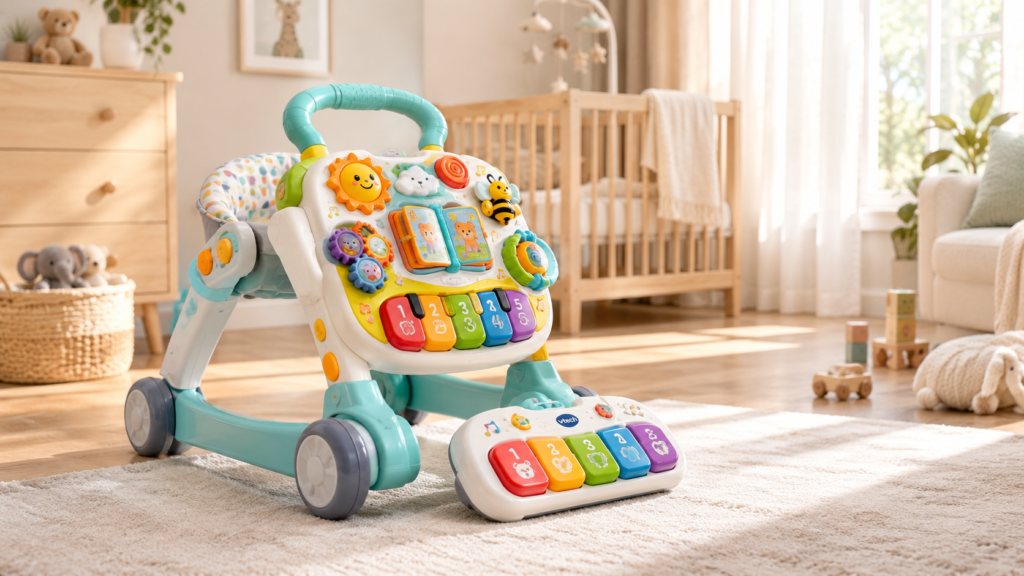
- Primary Feature: Detachable activity panel packed with over 70 songs, melodies, sound effects, and phrases.
Best For: Parents seeking maximum educational engagement, adjustable wheel speed, and total multi-stage adaptability.
Detailed Review:
The VTech Sit-to-Stand Learning Walker stands as the industry benchmark for push walkers, offering an unmatched combination of developmental entertainment and mechanical safety. Designed to support your child from floor play through independent walking, this unit features a removable front activity center equipped with five illuminated piano keys, three spinning gears, three shape sorters, a pretend telephone handset, and interactive barn doors.
From a physical safety standpoint, VTech excels with its two-speed control mechanism located on the rear wheels. Setting 1 provides increased friction for early walkers who require steady support, preventing the frame from shooting forward. Setting 2 releases wheel tension once your child gains confidence and stride balance. Constructed from durable, non-toxic, BPA-free plastic with smooth rounded edges, this walker provides outstanding lateral stability to handle vigorous toddler use.
Pros:
Two-stage wheel speed control prevents accidental slips on smooth floors.
Fully removable activity board ideal for seated floor play and travel.
Extensive audio and visual library introduces letters, numbers, and animals.
Sturdy, wide-stance frame resists tipping during sudden directional changes.
Cons:
Plastic wheel surface can occasionally slide on slick tile if speed lock is off.
High volume level requires setting management for sensitive ears.
👉 Click the link to check the price on Amazon
- Fisher-Price Learn with Me Zebra Walker
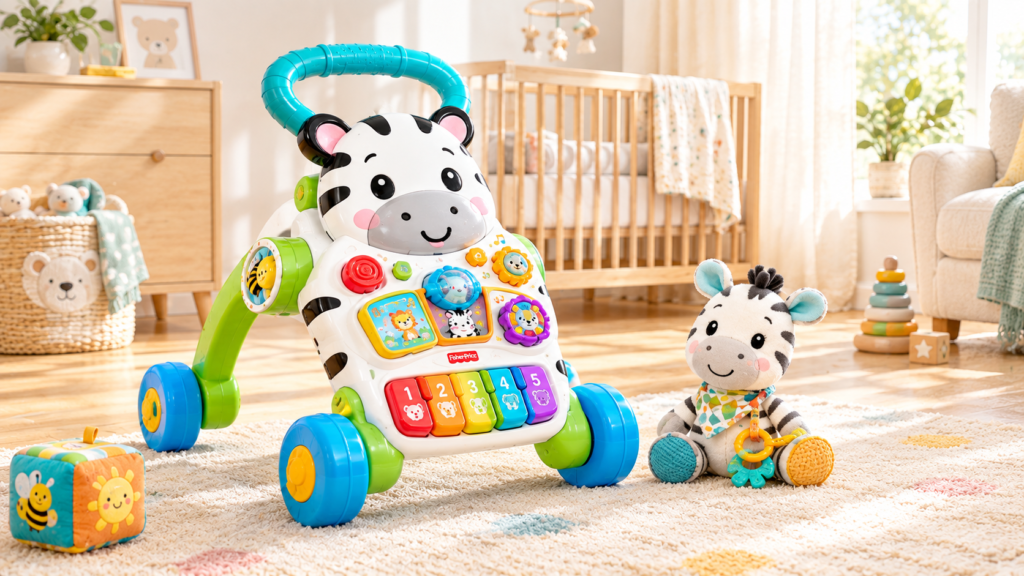
Primary Feature: Easy-grasp handle and broad 4-wheel stance with vibrant zebra-themed interactive panel.
Best For: Budget-conscious families seeking an intuitive, lightweight push walker that encourages confidence.
Detailed Review:
The Fisher-Price Learn with Me Zebra Walker offers an approachable, highly engaging design built around a friendly animal character that keeps babies motivated. From sitting to standing, this walker supports infants with an oversized, easy-grip handlebar that provides comfortable hand placement for small wrists during pull-up attempts.
The front panel features a light-up button that triggers playful songs and nursery rhymes, a flip book page for story-based exploration, and spinning rollers that build fine motor precision. While the front panel is fixed and cannot be detached, its low-profile seating height allows sitting infants to reach all buttons without strain. The broad, four-point wheel configuration provides reliable balance, making it a great lightweight choice for everyday indoor mobility.
Pros:
Ergonomic, broad handlebar design assists infants in pulling themselves up easily.
Affordable price point without compromising core structural stability.
Engaging music, phrases, and lights keep babies entertained during rest breaks.
Lightweight construction makes moving between rooms effortless.
Cons:
Front activity panel is not removable for portable floor play.
Lacks adjustable friction wheel locks for custom speed regulation.
👉 Click the link to check the price on Amazon
- LeapFrog Scout’s 3-in-1 Get Up & Go Walker
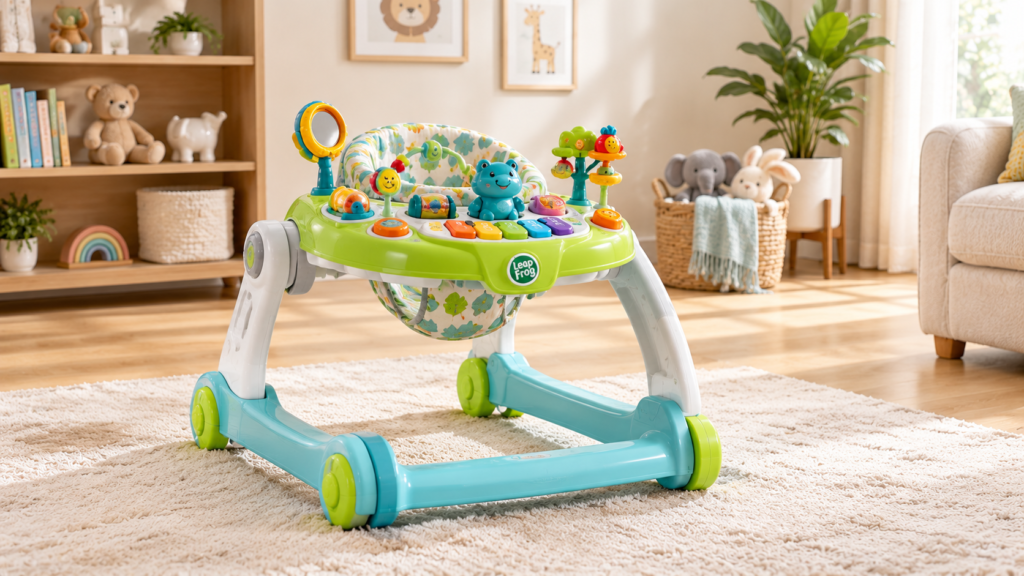
- Primary Feature: 3-in-1 convertible design (Baby Gym, Floor Activity Panel, and Walker).
Best For: Families wanting maximum long-term value from newborn play to active toddlerhood.
Detailed Review:
The LeapFrog Scout’s 3-in-1 Get Up & Go Walker is engineered for continuous versatility across your baby’s first two years. It converts seamlessly through three distinct growth phases: an overhead baby gym for lying infants, a flat interactive activity table for sitting babies, and a sturdy push walker for toddlers learning to walk.
Equipped with speed-control wheels, this walker ensures your child maintains stable forward momentum regardless of floor type. The Scout character panel includes piano keys, light-up buttons, and interactive content focused on early phonics, colors, and music. The durable structural frame features locked legs that provide exceptional resistance against tipping over during side-to-side leanings.
Pros:
3-in-1 convertible system spans from infant gym to toddler walker.
Adjustable wheel speed controls adapt to early vs. confident walkers.
Rich educational content powered by LeapFrog’s learning curriculum.
Exceptionally stable base prevents tipping during pull-up attempts.
Cons:
Takes up slightly more storage space due to the convertible frame.
Assembly requires switching between modes as baby grows.
👉 Click the link to check the price on Amazon
- Melissa & Doug Chomp & Clack Alligator Push Toy
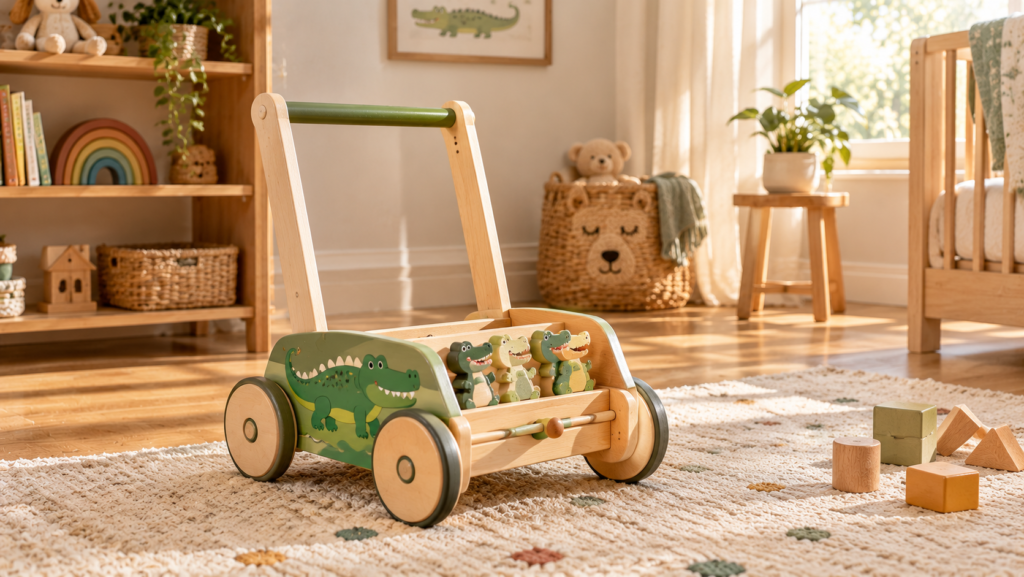
- Primary Feature: Handcrafted wooden construction with mechanical chomping alligators and wooden wheels.
Best For: Parents who prefer screen-free, non-electronic, natural wooden heirloom toys.
Detailed Review:
For parents who prefer traditional, screen-free toys without battery-powered electronic sounds, the Melissa & Doug Chomp & Clack Alligator Push Toy is an iconic choice. Made from sturdy hardwood and non-toxic paints, this push walker features three wooden alligators that alternate chomping and clacking with every step your baby takes.
It incorporates spinning butterfly and ladybug beads along the handle, adding tactile sensory play without electronic noise. The wooden wheels are lined with non-skid rubber strips, providing optimal grip on hardwood floors while protecting delicate floor finishes. Its heavier weight profile gives beginner walkers a grounded, solid feeling of security.
Pros:
100% battery-free, durable wooden craftsmanship built to last.
Rubber-lined wheels protect floors and offer steady traction.
Audory feedback from the chomping alligators encourages continued walking.
Heavyweight frame provides excellent anti-tipping stability.
Cons:
Lacks electronic learning features like letters or numbers.
Heavier structure may be harder to steer in small spaces.
👉 Click the link to check the price on Amazon
- Developmental Benefits of Push Walkers vs. Seated Walkers
- Promoting Natural Biomechanics and Balance
Unlike legacy seated walkers that allow infants to scoot around passively while relying on a canvas seat, push walkers demand active engagement. When an infant uses a sit-to-stand walker, they engage their core muscles, strengthen their ankles and knees, and practice bearing weight through their feet. This natural alignment builds proper posture, foot placement, and spatial awareness necessary for unassisted walking. - Fine Motor and Cognitive Stimulation
The front interface of a premium push walker functions as a standalone activity center. Features such as illuminated piano keys, spinning gears, shape sorters, and interactive books encourage babies to sit, reach, and manipulate small objects. This multi-sensory feedback strengthens hand-eye coordination, refines pincer grasps, and introduces early concepts like numbers, colors, shapes, and musical scales. - Extended Usability Across Growth Stages
Most high-quality interactive walkers feature removable activity panels. During the floor-play stage (typically around 6 to 9 months), babies can interact with the sound and light module while lying on their stomach or sitting upright. Once they begin pulling themselves up (around 9 to 12 months), the panel attaches to the push frame, converting the toy into an empowering walking aid that adapts as your child grows into a toddler.
Comparison of Top Interactive Baby Walkers
Instead of a rigid grid, here is a detailed breakdown of how these top four push walkers stack up across key structural and developmental features:
VTech Sit-to-Stand Learning Walker
Primary Advantage: Maximum educational engagement featuring over 70 sound effects, phrases, and multi-stage adaptability.
Recommended Age: 9 to 36 Months.
Speed Tension Control: Yes (features a dedicated 2-stage speed adjustment mechanism on the rear wheels).
Activity Panel: Fully removable for floor play, tummy time, and travel convenience.
Fisher-Price Learn with Me Zebra Walker
Primary Advantage: Most budget-friendly choice featuring an ergonomic, easy-grip handlebar designed for small wrists.
Recommended Age: 6 to 36 Months.
Speed Tension Control: Standard rolling resistance with friction-based wheel placement.
Activity Panel: Fixed panel (integrated directly into the push frame).
LeapFrog Scout’s 3-in-1 Get Up & Go Walker
Primary Advantage: Outstanding 3-in-1 modular system that converts effortlessly from baby gym to activity table to push walker.
Recommended Age: 6 to 36 Months.
Speed Tension Control: Yes (includes adjustable speed settings tailored for early vs. confident walkers).
Activity Panel: Convertible multi-position frame with core phonics focus.
Melissa & Doug Chomp & Clack Alligator Push Toy
Primary Advantage: Premium screen-free wooden heirloom craftsmanship with physical, noise-making mechanical feedback.
Recommended Age: 12 Months and up.
Speed Tension Control: Heavyweight wooden frame paired with natural friction rubber-strip wheels.
Activity Panel: Built-in tactile wooden features including spinning beads, sliders, and mechanical chomping alligators.
Buyer’s Guide: Essential Parameters for Push Walkers
Selecting the safest, most effective sit-to-stand walker requires evaluating specific mechanical and structural characteristics. Keep these technical parameters in mind before making your final purchase:
Wheel Traction and Surface Compatibility: Always ensure the walker features non-skid rubber strips or adjustable tension knobs. Plain plastic wheels without rubberized grip can easily slide out from under an early walker on slick hardwood, laminate, or polished tile floors.
Base Stability and Center of Gravity: Look for a broad, wide-stance frame with a low center of gravity. The rear legs must offer plenty of clearance so your baby’s feet do not bump into the wheels while stepping forward, which could cause tripping.
Non-Toxic and Child-Safe Construction: Infants actively explore their gear using their mouths. Verify that plastic push walkers are completely free of BPA, PVC, and phthalates, and ensure that wooden models utilize non-toxic, child-safe, water-based paints and finishes.
Sensory and Educational Variety: Select models offering diverse tactile, auditory, and visual activities. Variable mechanical elements prevent boredom and keep your child actively engaged across multiple cognitive leaps.
Pediatric Safety Rules for Using Push Walkers
While modern sit-to-stand push walkers are significantly safer than traditional legacy seated walkers, parents must maintain strict, proactive safety protocols during play sessions:
Block Off Stairs and Drop-Off Hazards: Always install sturdy, hardware-mounted safety gates at the top and bottom of all staircases. A moving push walker can quickly gain momentum near uneven steps or ledges.
Eliminate Household Floor Hazards: Thoroughly clear play area floors of loose rug edges, small objects, power cords, and low coffee tables with sharp corners. Ensure heavy furniture items (such as bookshelves and dressers) are securely anchored to wall studs.
Maintain Active Adult Supervision: Never leave an infant unattended while using a walker, even for a brief moment. Sudden loss of balance or direction changes can occur within seconds.
Limit Session Durations for Ergonomic Health: Pediatric physical therapists recommend balancing push-walker practice with plenty of unrestricted floor play, tummy time, and barefoot exploration to promote healthy hip alignment and spinal development.
Frequently Asked Questions (FAQs)
Are sit-to-stand push walkers safe for baby development?
Yes, push walkers are widely supported by pediatric experts because they require infants to bear their own body weight, practice balance, and build core muscle strength naturally—unlike traditional seated walkers that can cause unnatural toe-walking and alter hip mechanics.
What is the ideal age to introduce an interactive push walker?
Most infants can interact with detachable floor panels starting around 6 months. Actual push-walking features should be introduced between 9 and 12 months, once your baby demonstrates the physical strength to pull themselves up to a standing position independently.
Should my baby wear shoes while using a push walker indoors?
Barefoot play is ideal indoors! Walking barefoot allows your baby’s toes to grip floor surfaces naturally, strengthening foot arches, improving ankle stability, and delivering vital sensory feedback directly from the ground.
How do I clean and sanitize an interactive baby walker?
For electronic panels, wipe surfaces with a damp cloth lightly sprayed with mild, baby-safe detergent or water-vinegar solutions. Never submerge electronic parts in water. For wooden push toys, wipe clean immediately after spills and avoid harsh chemical cleaners that could degrade non-toxic paints.
Final Verdict: Which Walker Should You Choose?
Investing in an interactive learning baby walker is one of the most rewarding decisions you can make for your child’s early physical independence and cognitive growth.
If you want maximum educational value, custom wheel speeds, and multi-stage longevity, the VTech Sit-to-Stand Learning Walker remains the undisputed top choice.
For parents seeking an affordable, straightforward option with an ultra-sturdy grip, the Fisher-Price Learn with Me Zebra Walker provides outstanding overall value.
If you prefer a natural, screen-free, heirloom toy built from durable hardwood, the Melissa & Doug Chomp & Clack Alligator Push Toy is a timeless favorite.
Equip your nursery with the right walker today, set up a safe home environment, and enjoy watching your little one confidently step into their independent world!
We hope this article has provided you with valuable information about this topic and helped you make a better and more informed choice for your little one.
Thank you for reading our article!
Affiliate Disclaimer: SmartKidsGear is reader-supported. When you purchase through links on our site, we may earn an affiliate commission at no extra cost to you.